Clear Ahead learns from how you work — your typing rhythm, task switching, interruptions, and recovery — to estimate when your mental effort is rising.
Over time, it shows you which patterns help you focus, which ones drain you, and how to structure your day so you can do better work with less unnecessary strain.
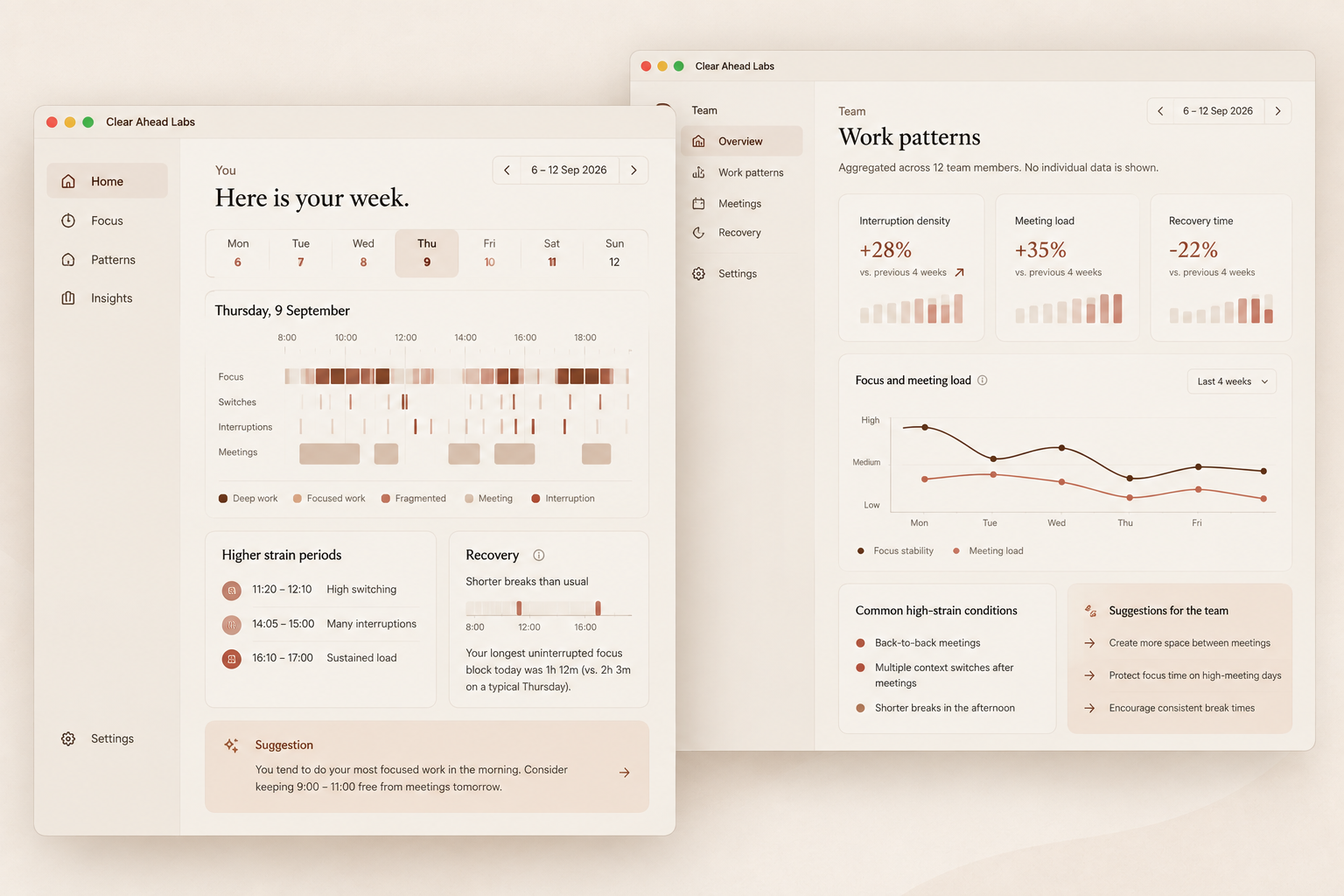
Your focus is most stable between 9 and 11. On the last three Thursdays it fragmented after a run of early interruptions.
Protect 9 to 11 today and hold low-priority work until after. Recovery yesterday was short.
Cognitive strain is invisible until it becomes something else.
Working memory has limits. Sustained load, constant switching and too little recovery use them up. Physical fatigue you can feel; cognitive strain mostly shows up later, as slower decisions, avoidable mistakes, work you know is not your best, and eventually burnout. By then it is expensive for the person and the organisation, and nobody saw it coming.
£51bn
What poor mental health costs UK employers each year. The largest share is presenteeism: people at work but depleted.Deloitte, 2024
2 min
Average gap between interruptions for a Microsoft 365 user: a meeting, an email or a notification.Microsoft Work Trend Index, 2025
58%
Share of knowledge workers' time spent on work about work rather than skilled work.Asana Anatomy of Work, 2023
How it works
1 — Signal
Behavioural proxies, captured passively
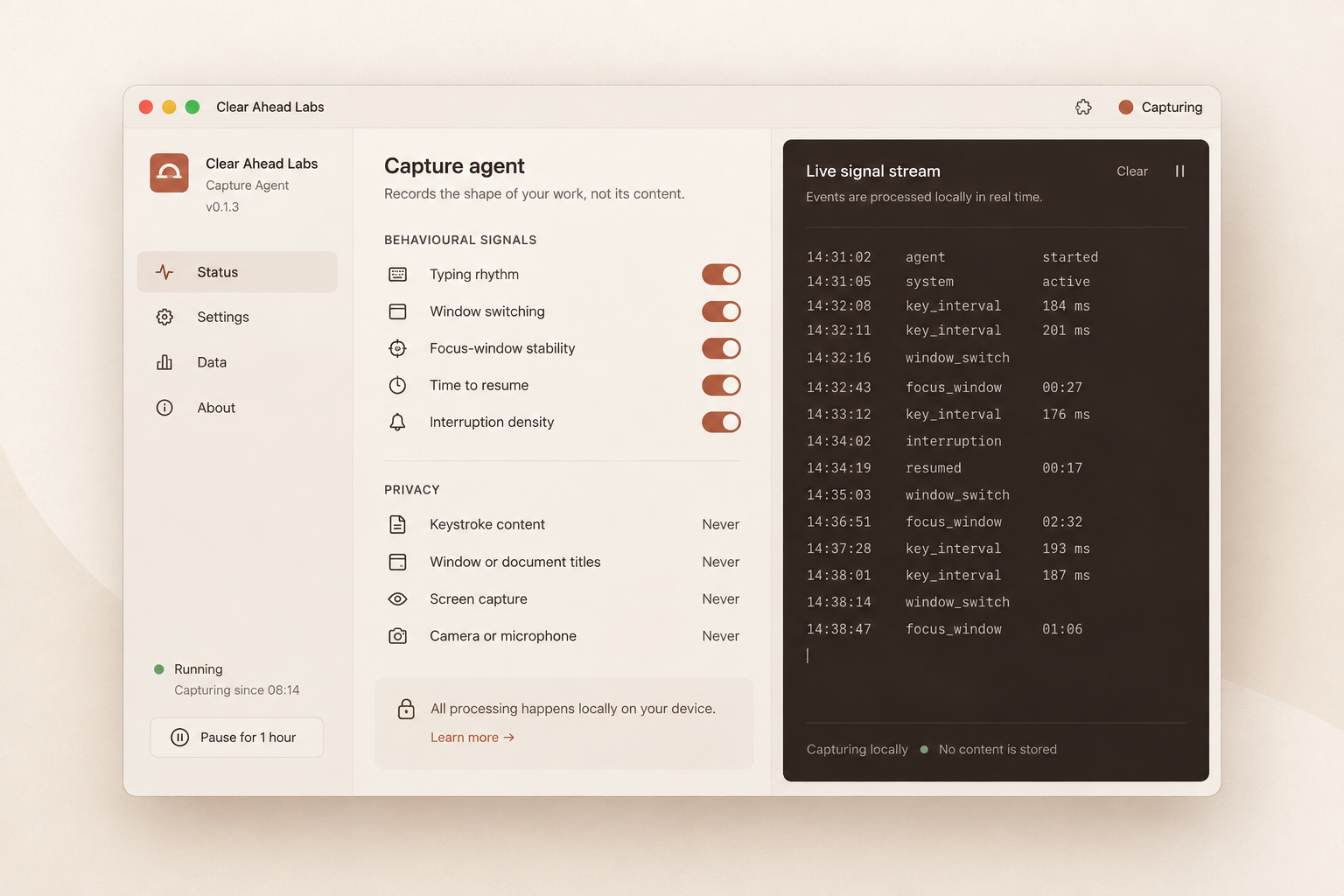
A lightweight desktop agent records the shape of your work, not its content. No wearables, no surveys, nothing to fill in.
Typing rhythm and its variability
Task and window switching frequency
Focus-window stability
Time to resume a task after an interruption
Interruption density and checking loops
Not recorded: what you type, what you read, which documents or messages you open, your screen, your camera.
2 — Inference
A model that reads patterns over time
No single event means anything. The model looks at how these signals move together across hours and days to estimate strain, recovery deficit and remaining capacity for sustained focus, relative to your own baseline rather than anyone else's.
Longitudinal: trajectories, not snapshots
Personal baseline, learned over weeks
Calibrated against how people say they feel, not guessed
Not a medical device and not a brain model. It estimates a work-pattern signal with known limits, and says so.
3 — Feedback
Private to you, aggregated for your team
You see your own high-strain periods, fragmented blocks, recovery gaps and the conditions under which you do your best work. Your organisation sees only patterns across a team: interruption density, meeting load, recovery pressure.
Individual view: yours, on your machine
Team view: aggregates, never individuals
Suggestions, not instructions
Not a productivity score, not a ranking, not something a manager can open about you.
What the inference layer is looking for: strain climbing above a person's sustainable load mid-week, driven by interruption density, and not coming back down before the next demand arrives.
Where the idea comes from
Cognitive Load Theory established that working memory is limited and that badly structured demand degrades performance. Decades of research on interruptions and task switching measured the cost of fragmented work in the lab. What has been missing is a way to observe that cost in real work, continuously, without intruding on it.
Sweller, J. (1988). Cognitive load during problem solving. Cognitive Science, 12(2).
Why behavioural signals
Typing dynamics, switching behaviour and resumption latency have documented relationships with mental workload, and they can be captured from an ordinary computer with nothing attached to the person. They are proxies, not measurements of the brain, and the model is built to treat them that way: probabilistic, personal, and honest about uncertainty.
Why existing tools do not see it
They assume the problem is discipline, screen time or a badly arranged calendar. None of them measure cognitive condition: the state of a person's capacity right now.
Tool
What it measures
What it cannot see
App blockers, screen-time dashboards
Minutes per app
Two people with identical screen time and completely different cognitive states
Focus timers
That a 25-minute block happened
Whether anyone was actually focused during it
AI calendar assistants
The shape of your schedule
What you bring into the meeting, and what it leaves behind
HR and workforce analytics
Surveys and output, after the fact
The employee's own state, and it reports to the employer, not to them
Clear Ahead Labs
Strain and recovery inferred from work patterns, continuously
Content, identity at team level, or anything the person has not consented to
Built so it cannot become surveillance
A tool that watches how you work could very easily become a tool for watching you. We treat that as the central design constraint, not a policy to add later.
What holds
Individual data is processed on your own machine and belongs to you
Your organisation receives aggregates only, never individual data
Participation is opt-in and can be withdrawn at any time
The capture layer is open source, so the constraints are inspectable rather than promised
What is never collected
Keystroke content, only timing and rhythm
Message or document content, titles or recipients
Screen recordings, camera, microphone or biometrics
Anything a manager could use to evaluate an individual
We are building this first with knowledge-work organisations: engineering, consulting, research and professional services teams that already carry the cost of burnout and want an earlier signal than a resignation or a sick note. The organisation is the customer. The employee is the protected user.
What a team lead sees
Interruption density across the team, week over week
Meeting load in the hours people report as their best
Recovery pressure: demand arriving before the last peak has settled
Whether focus-time policies are actually changing anything
What a team lead never sees
Any individual's strain, patterns or signals
Who was working when, or on what
A score, rank or comparison between people
Anything the team has not agreed to share
In the Netherlands employers carry up to two years of paid burnout leave. Elsewhere the cost is measured in presenteeism, turnover and error. Either way, it is already being paid; it just is not being measured.
Early access
We are building the first version with a small number of knowledge workers and teams who feel the problem and want to shape the answer. Leave an email and we will write once, when there is something to try.
No newsletter. One message when we are ready for you.